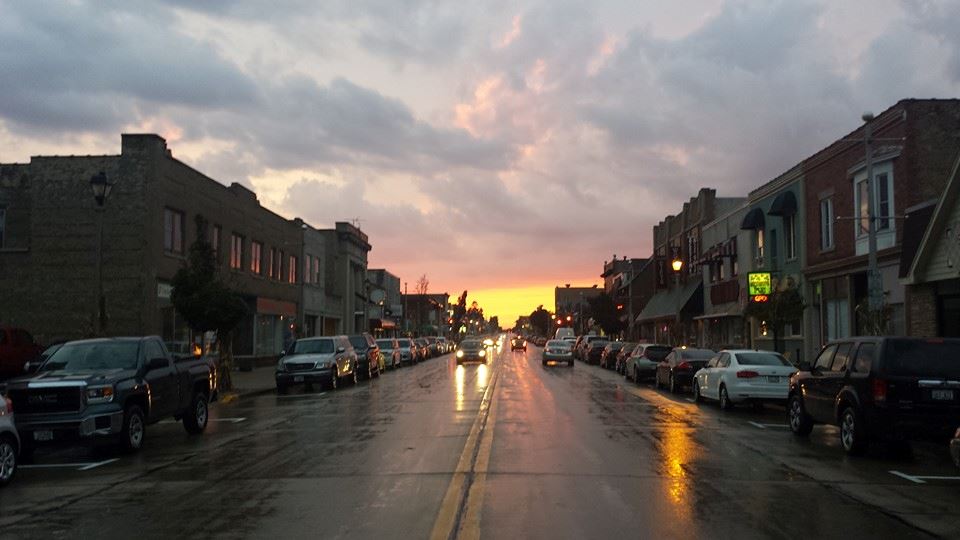
South Milwaukee’s 2035 Comprehensive and Downtown Plan Update developed at a decisive moment in the city’s history. With shifts in the local marketplace, workforce, and housing inventory, the city was looking to chart a new course that would add social and economic value through the creation of sustainable and resilient strategies to strengthen community amenities and capitalize on opportunity areas.
The comprehensive planning process involved the coordination of efforts between multiple City committees, including the Plan Commission and Downtown Advisory Committee. South Milwaukeeans contributed to the effort at two community open houses: the Downtown Farmers’ Market in July 2015 and the citywide Halloween Trick-or-Treat in October 2015 on Milwaukee Avenue.
South Milwaukee’s 2035 Comprehensive and Downtown Plan Update approached the process differently by reorganizing the State-mandated components to present content and data that would serve to generate creative development strategies and projects. The Plan elements provide a focused analysis of South Milwaukee’s neighborhoods, districts, and corridors to encourage community-sensitive development. South Milwaukee’s plan included:
- A Citywide Economic Development Discussion
- A Community Profile to Detail Existing Community Characteristics
- A Downtown Plan
- An Extensive List of Implementation Strategies to Operationalize City Needs and Desires
- A Series of Chapters Describing City Systems
Listed in the following, is a summary of the chapters within South Milwaukee’s 2035 Comprehensive and Downtown Plan:
Community Profile (Pages 7 Through 24)The "Community Profile" describes South Milwaukee by its community heritage and demographic trends. The element’s text initially places the city within its regional context and develops its historical significance. What follows is a presentation of demographic data that outline the make-up of the city’s residents:
- Age Distribution
- Educational Attainment
- Employment Characteristics
- Population Size
- Race and Ethnicity
- Schools
The "Neighborhoods, Districts, and Corridors" (NDC) element redefines land use in South Milwaukee to approach land use management from the perspective of encouraging mixed uses places that foster a cohesive, integrated community. This approach satisfies the compliance requirements for Wisconsin State planning legislation. Redefining land use into NDCs integrates places within the city to reinforce community identity and pride by connecting people’s homes with retail, activity centers, and jobs. This element goes further and provides a matrix for preferred land uses to ensure the preservation of existing uses with the facilitation of future development through an easy-to-understand guide.
Downtown District (Pages 57 Through 114)A unique feature of South Milwaukee’s 2035 update is the inclusion of a Downtown Plan. With numerous historical structures and a core business district, Downtown is the city’s hub of activity. To revitalize the eight block expanse along Milwaukee Avenue, the consultant team conducted a market analysis to determine the viability of the downtown’s market and marry that knowledge with nine broad implementation strategies further supported by individual actions.
Systems (Pages 115 Through 158)Much of a community’s cultural and physical infrastructure can be grouped under the broad category of "Systems." These are the amenities, assets, and facilities that make transportation, business, healthy living, and education possible.
- Transportation (Pages 116 Through 121) - The "Transportation" element catalogues existing roadways, highways, railroads, transit service, bicycle facilities, and pedestrian accommodations. It then discusses current considerations of and needed improvements to each of these systems and how different modes of transportation can be integrated.
- Housing (Pages 122 Through 127) - As one of the most critical components in a community, an affordable and quality housing stock provides the stability needed to support thriving community activity. The "Housing" element presents South Milwaukee’s three kinds of housing: single family, multi-family, and affordable and special needs housing. As the city only has select areas of available land for future development, the housing stock has largely remained constant in recent years. As a result, the goals and implementation strategies focused on ensuring the continuous supply of quality, affordable housing while guiding future housing construction in the Opportunity Areas.
- Natural and Agricultural Resources (Pages 128 Through 141) - As a Parkway City, South Milwaukee is the envy of numerous Southeastern Wisconsin communities because of the Oak Creek Parkway, Grant Park, and its proximity to Lake Michigan. As both are highly valuable community resources and attractions to the city for visitors and potential residents, the parks and lakefront are treasured both socially and economically. The "Natural and Agricultural Resources" elements sets forth a series of goals and implementation strategies to both protect the city’s green space and capitalize on it for economic gain. In addition, South Milwaukee’s community garden receives due consideration.
- Historical and Cultural Resources (Pages 142 Through 149) - With over a century worth of history, South Milwaukee has a rich heritage with families that have called the city home for generations. The "Historical and Cultural Resources" elements discusses the South Milwaukee Performing Arts Center, the Downtown Market, the numerous community events and celebrations, and historic buildings. The city’s history lives on because the residents of South Milwaukee retain their community pride and continue to host and attend community events.
- Utilities and Community Facilities (Pages 150 Through 158) - To guide the maintenance and construction of utility infrastructure and community facilities, this element catalogues South Milwaukee’s schools, public safety, library, post office, Yacht Club, water infrastructure, and waste disposal. As the city developed, so did its current utilities’ capacity. At present, the city does not foresee or predict a need for utility because supply meets demand.
Economic development and Downtown revitalization are inextricably linked in the city’s comprehensive plan. Whereas the Downtown Plan focuses exclusively on the eight-block stretch along Milwaukee Avenue, the "Economic Development" element further develops other activities and areas within the city that can attract investment. The element discusses the local economic base, the employment profile, brownfield remediation and tools, and public funding and resources available to strengthen businesses and support the local workforce.
This element is also unique in that it identifies and proposes development scenarios at the key Opportunity Areas in the city. Multiple downtown sites, former manufacturing facilities along the Oak Creek Parkway, and the Ebbs Creek site are presented with hypothetical redevelopment site plans and accompanying narrative to describe each site’s potential.
Implementation (Pages 182 Through 207)The "Implementation" element sets forth the strategies that will operationalize the ideas presented in the plan and the community’s needs and desires gathered during the public engagement process. The strategies are presented in tables - similar to a "To Do" list - and allow each strategy to be easily identified with its timeline and the party responsible for implementing it. Additionally, this element also outlines how South Milwaukee can cooperate with surrounding municipalities. As South Milwaukee has good working relationships with these municipalities and is an active member in the South Shore Chamber of Commerce, opportunities for cooperation will strengthen the city and neighboring communities.